


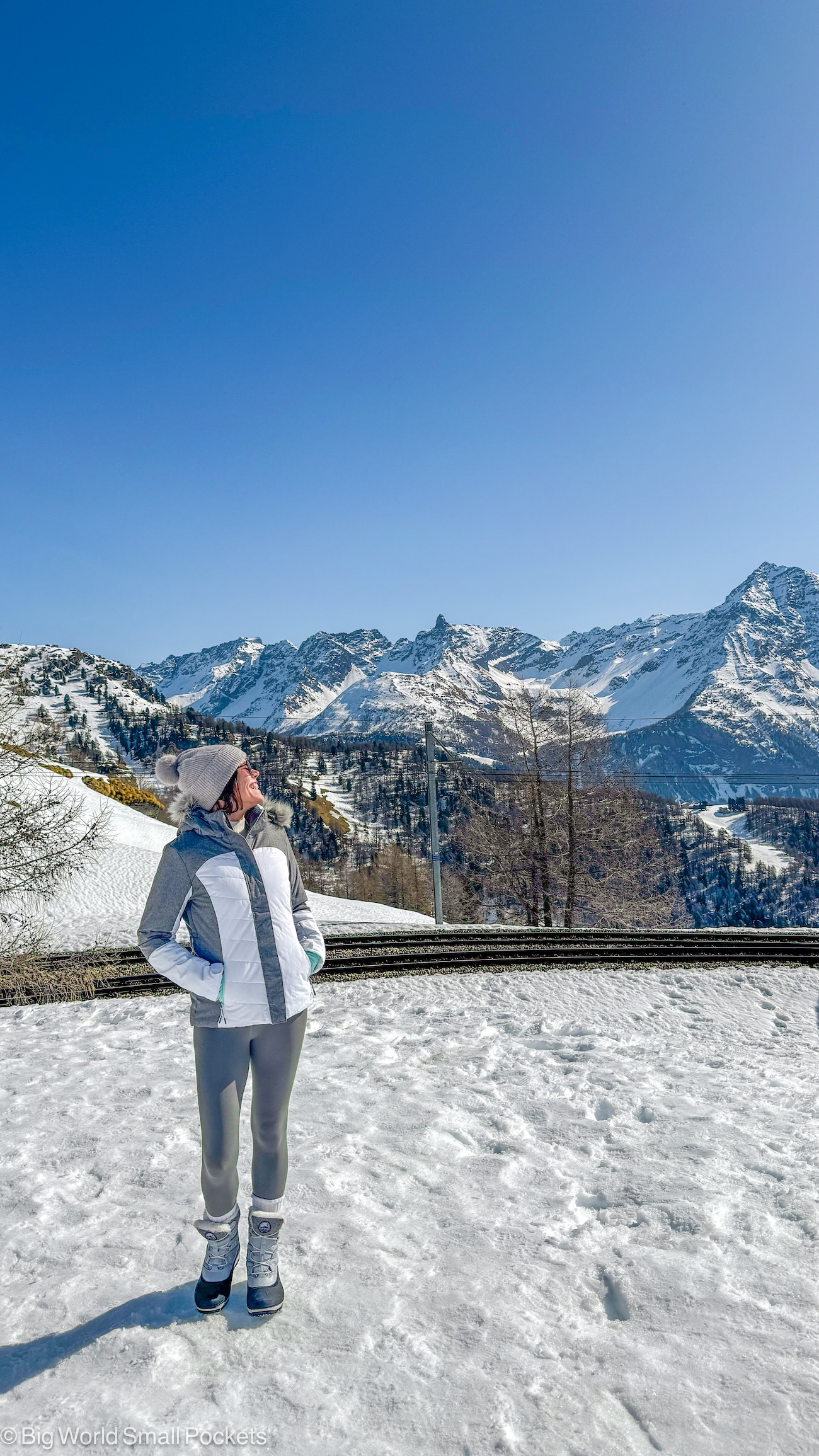
There is something spellbinding about the Bernina route.
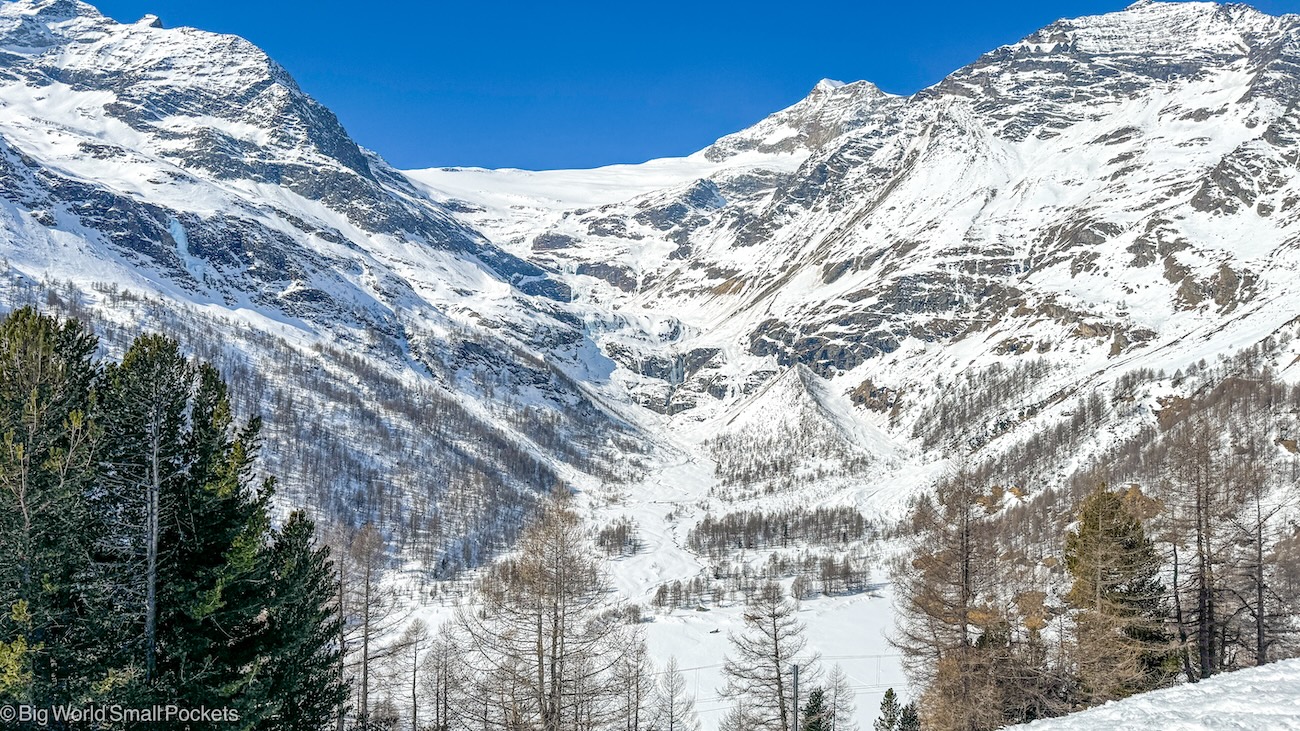
Sweeping past glaciers, turquoise lakes, spiralling viaducts and high mountain passes, it is one of Europe’s most extraordinary rail journeys and firmly earns its UNESCO stamp.
Most travellers assume the only way to experience it is by booking the official Bernina Express, a panoramic tourist train, but they’re wrong!
You can travel the exact same route on a regular public train for about half the cost!
Yes, the very same tracks, the very same scenery, and the very same engineering wonders that make this line so iconic.
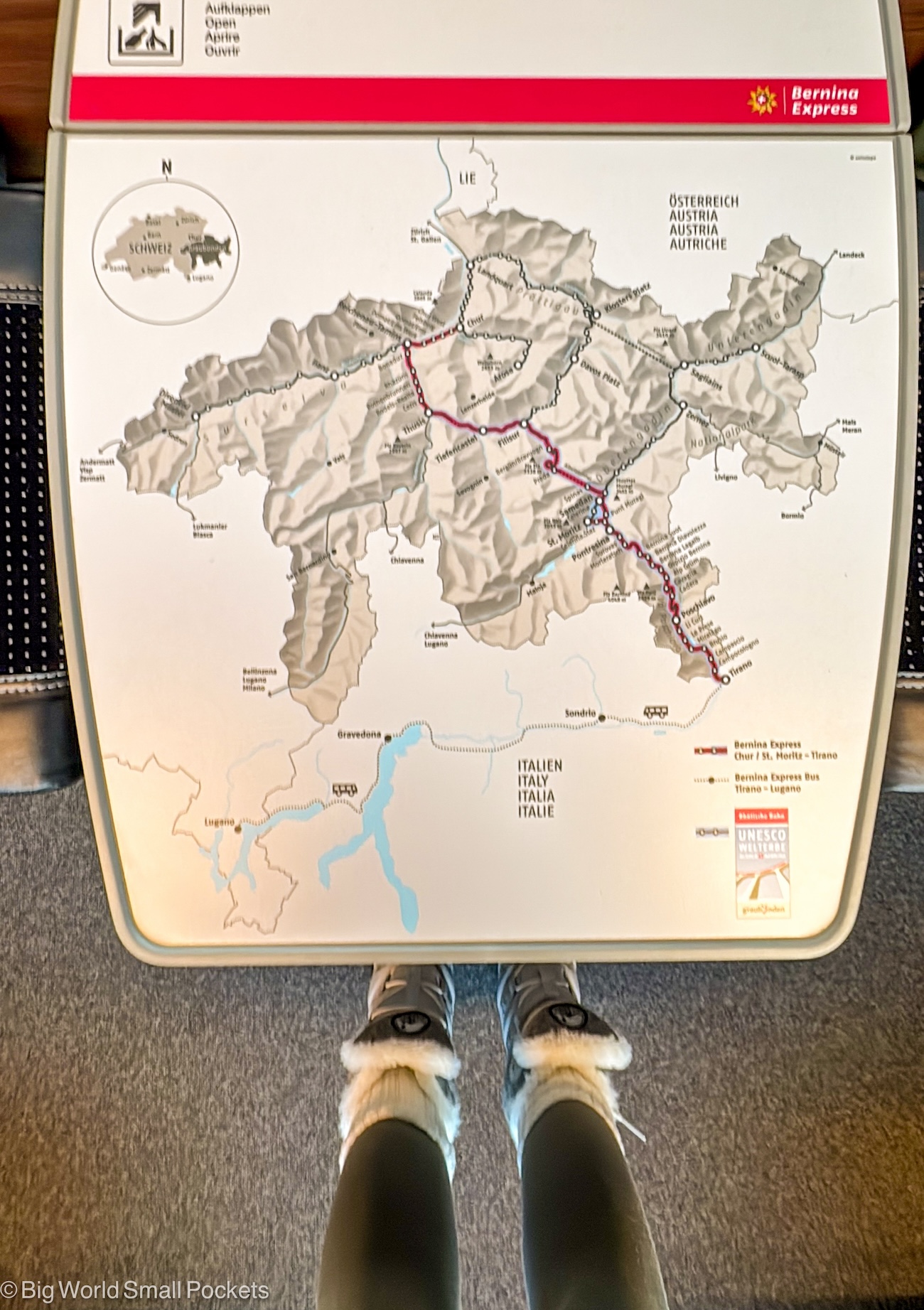
These regional trains are the ones local passengers use, running all day, every day, along the full Bernina line between Chur or St Moritz, and Tirano in northern Italy.
They follow precisely the same UNESCO path as the Bernina Express and all you need is a standard Swiss ticket.
It is easily one of the most underrated tricks in Swiss travel!
While the Bernina Express is lovely, the regional trains give you the same mountains for a fraction of the price… what’s not to love?!
Related Posts
- Ultimate Guide to Planning Your Bernina Express Trip
- 10 Best Things to Do in Chur, Switzerland for Short Stay Visitors
- Swiss Alp Splendour: My Bucket List Ride on the Bernina Express
Bernina Express vs Regional Train: What’s the Difference?
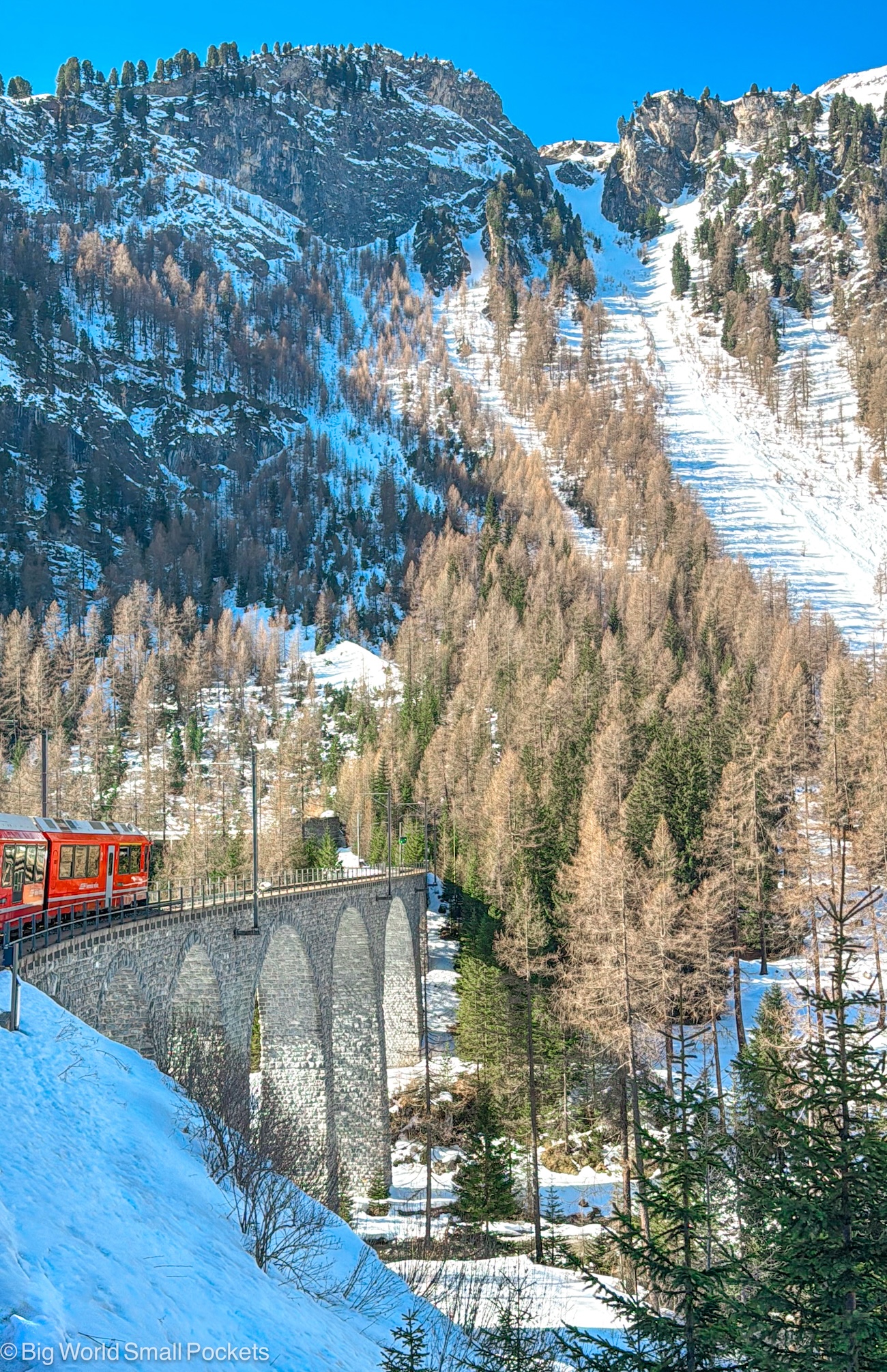
To kick things off, it helps to understand what separates the two services, as both share the route, but the experience varies in a few, distinct ways.
Bernina Express Train
The Bernina Express is the famous panoramic sightseeing train.
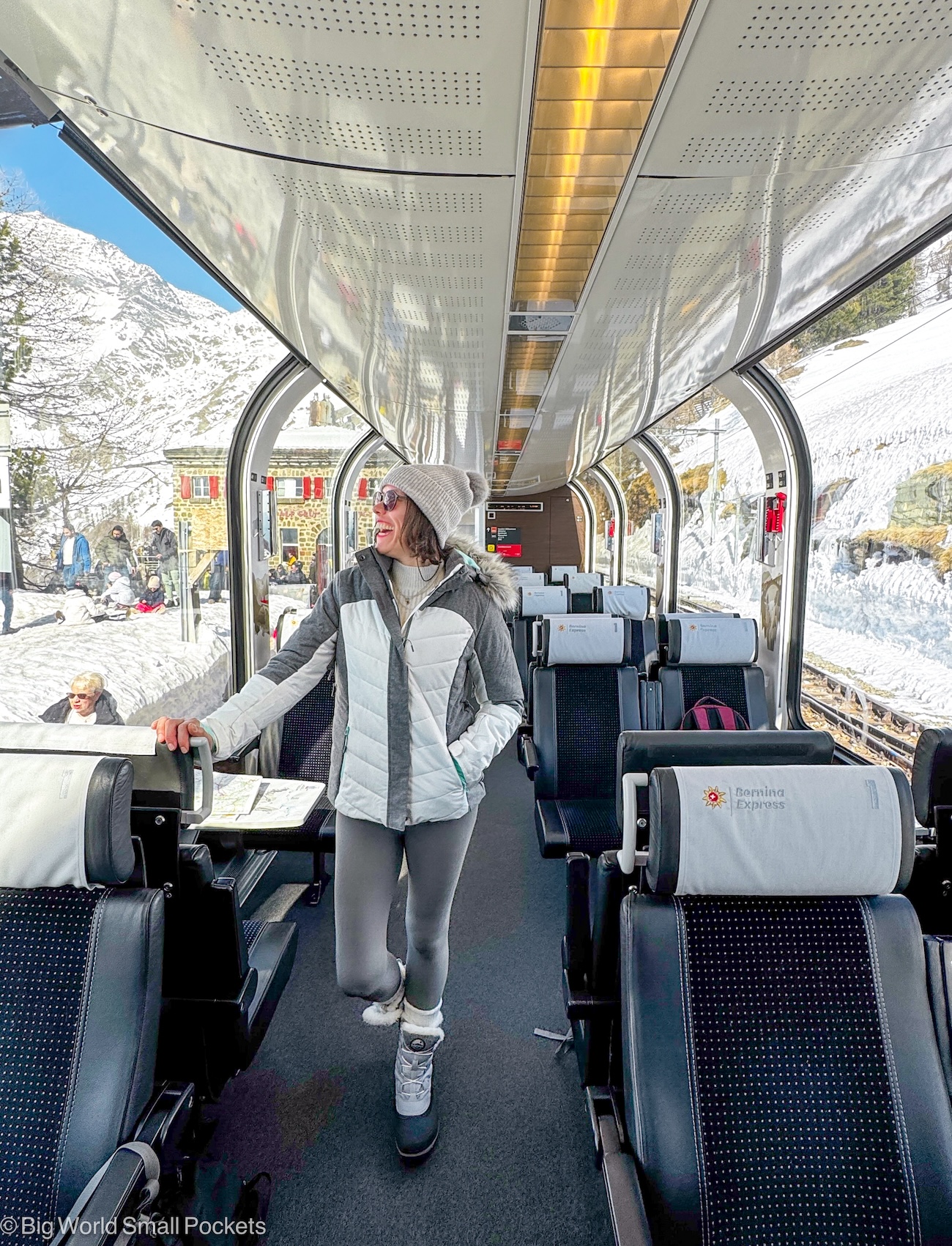
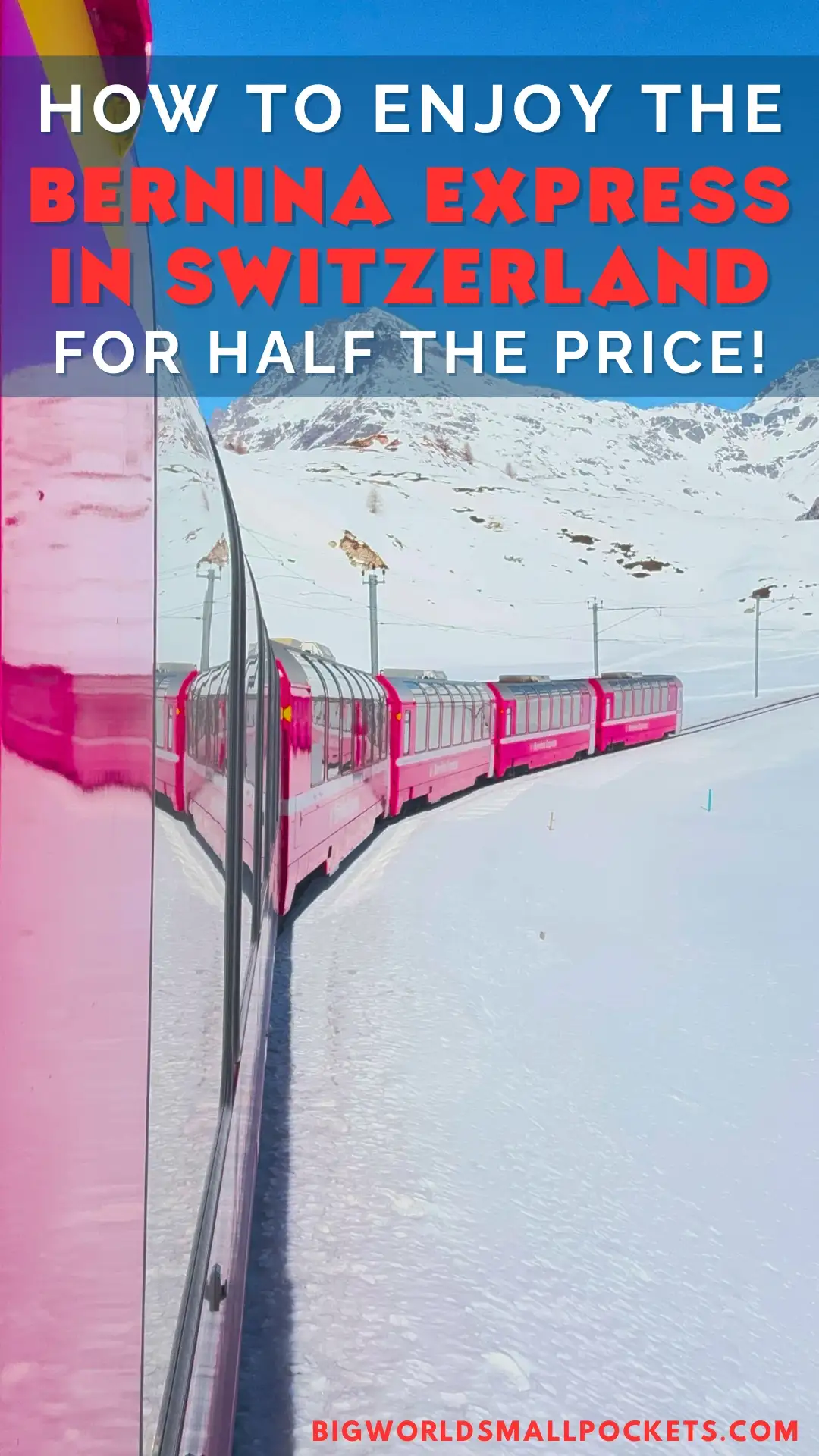
Its most recognisable feature is the huge curved windows that run right up the sides of the carriage, which create a sort of glass capsule feeling, ideal for soaking up views without moving your head.
The downside is that these windows do not open, which means reflections in photographs, especially on sunny days.
The train usually runs direct and seat reservations are compulsory.
These reservations carry an extra cost on top of your normal ticket and they often sell out in busier months.
Regional Train
The regional train is the everyday public service.
These trains run the full Bernina line and are primarily designed for locals, commuters and travellers hopping between alpine towns.
The windows open, which is brilliant for photographers.
There are no seat reservations, so everything works on a first come, first served basis. This is a huge perk for spontaneous travel, but does mean getting to the platform a little early during summer.
Prices are significantly cheaper because you only pay for a standard ticket with no supplements.
You may need to change trains once or twice on longer journeys, especially if travelling all the way from Chur to Tirano, but the connections are easy and designed to line up.
In Summary
Put simply, the Bernina Express is a polished tourist experience, while the regional train is a flexible, budget-friendly alternative with excellent photo opportunities.
The scenery is identical.
How to Book the Cheaper Regional Train
Let us get to the practical part.
You can book the regional train in 3 easy ways. None of them require anything complicated, and you do not need to book months in advance.
- SBB website: Switzerland’s national railway website is the most accurate place for timetables and fares. Search for journeys like Chur to Tirano, or St Moritz to Tirano.
- SBB app: Clean, simple, and incredibly reliable, you can buy tickets instantly here, store them on your phone, and double-check platforms quickly on arrival.
- Trainline: If you’re used to booking everything in one place, Trainline also sells the regional train tickets with a small booking fee.
With all these platforms, the same rules apply – pay attention to the train codes when booking rather than the marketing.
Here is what you are looking for when it comes to train codes…
1. BEX Trains
This is the Bernina Express, aka the panoramic tourist train.
It is the only one you should avoid if you want the cheaper route.
BEX usually operates as a direct train and always requires a separate reservation fee.
2. RE Trains
This stands for Regional Express and is the prime candidate for the budget version of the Bernina experience.
These trains follow the UNESCO route with fewer stops and often run the longest sections of the journey.
They are fast, comfortable and excellent for photos.
3. R Trains
This stands for Regional and are trains that make more local stops and run at a slower pace.
They are perfect if you prefer a more leisurely, hop-on-hop-off style day, but still want the Bernina scenery.
4. IR Trains
Occasionally you will see InterRegio on sections of the wider network too. These are also regional trains on the Bernina Express line.
When the timetable appears, simply select the RE, R or IR journeys for your chosen date and route.
Those are all the public regional trains that follow the exact same track as the Bernina Express, just at different speeds.
Do You Need to Book Far in Advance?

Not with the regional trains!
Unlike the Bernina Express, these regional trains operate like any other Swiss public service, which means no seat reservations and no fixed capacity limits.
You can book weeks ahead, the night before, or even at an in-person ticket machine just before departure.
Prices do not fluctuate and there is no surcharge for booking late.
This makes the regional version a dream for spontaneous travellers, or anyone who does not want to commit to a rigid timetable!
What if You Have a Swiss Travel Pass?
Even better!
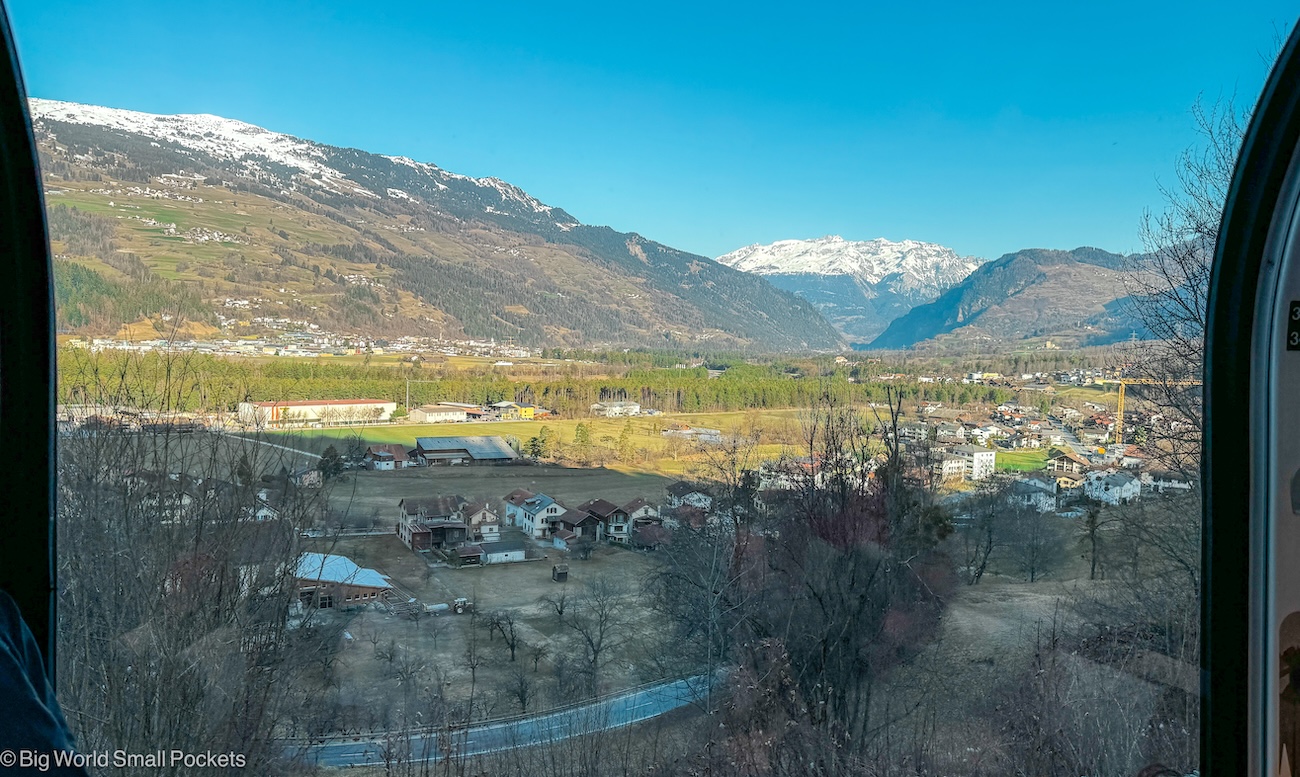
The entire Bernina line is included in the Swiss Travel Pass.
Simply jump aboard the regional train on the day and enjoy the journey.
No reservation and no extra charges.
If you try to use the Bernina Express with a rail pass, you still need to buy the compulsory seat reservation as an extra, so the regional train is the easiest and cheapest option by far.
Do You Need Seat Reservations?
Not on the regional train. This is one of its great advantages.
The panoramic Bernina Express requires a compulsory seat reservation, which is where a lot of the cost comes in.
The regional train works the same way every other Swiss regional service does – first come, first served. No hassle.
If you want a good window seat, arrive 15-20 minutes before departure time. That is usually enough to bag you a prime window spot.
In peak summer, a little more time is sensible, but it is still generally very chilled.
Will You Need to Change Trains?

Usually yes, although the changes are very easy.
The Bernina Express generally runs as a direct service, while many regional journeys involve one or two connection points, often at Samedan, Pontresina or St Moritz.
These transfers are usually timed perfectly, often with just a few minutes between trains, and the platforms are clearly marked.
Swiss connections are famously reliable.
If your journey planner shows a five minute change, trust it.
These are designed connections and the onward train will wait if needed.
Frequency and Flexibility
This is another huge advantage.
Regional trains on the Bernina route run roughly every hour, all year round, in both directions.
You are not tied to the single Bernina Express departure of the day, which is particularly helpful in winter when daylight hours are tight.
You can set off early for morning light, break up the route for alpine stops, or linger longer if somewhere catches your eye.
If you miss a train, simply catch the next one – simples!
Do the Regional Trains Run All Year?

Yes, they run year-round.
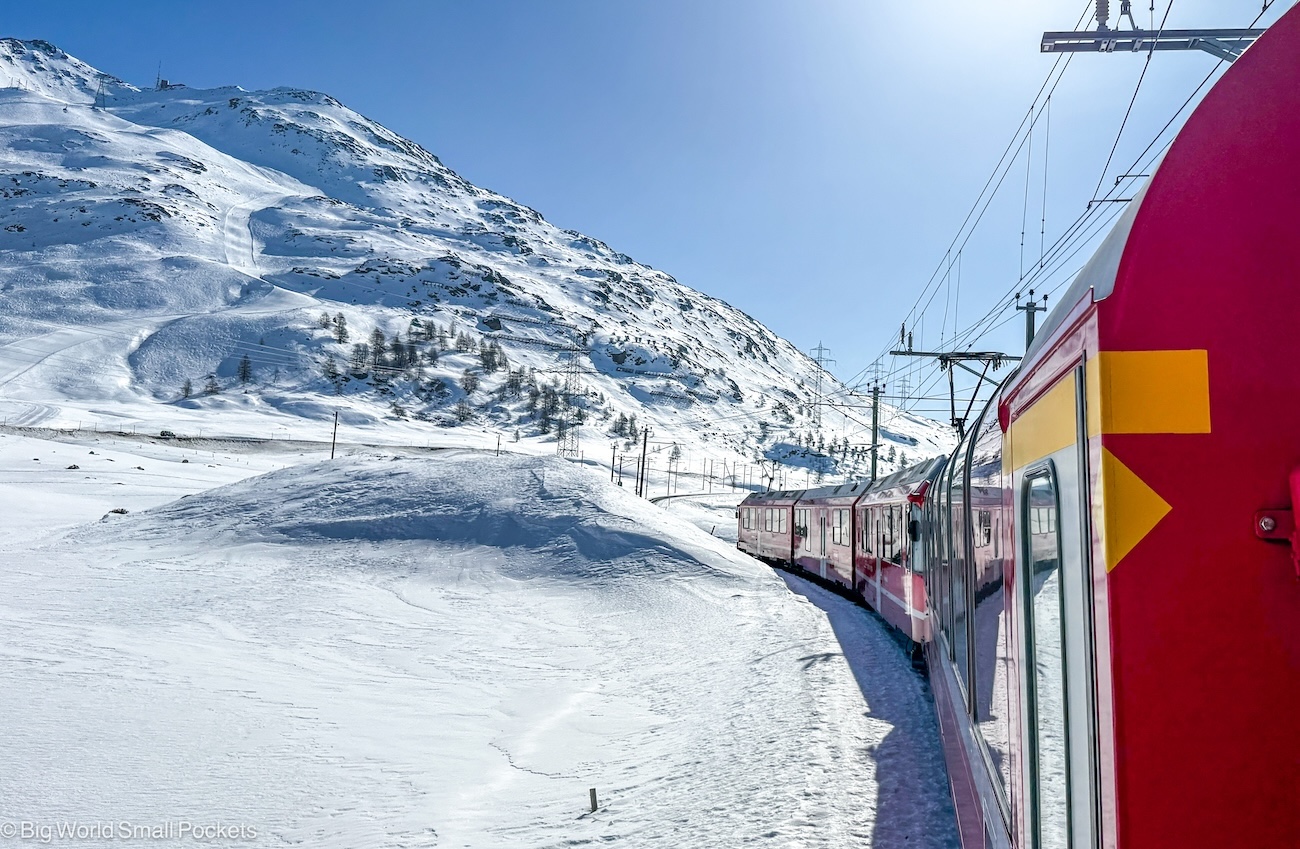
The Bernina line is engineered to withstand deep snow, winter storms and steep gradients, and it is ploughed religiously.
Do the Windows Open for Photos?

Yes. This is the reason photographers often prefer the regional train to Bernina Express train.
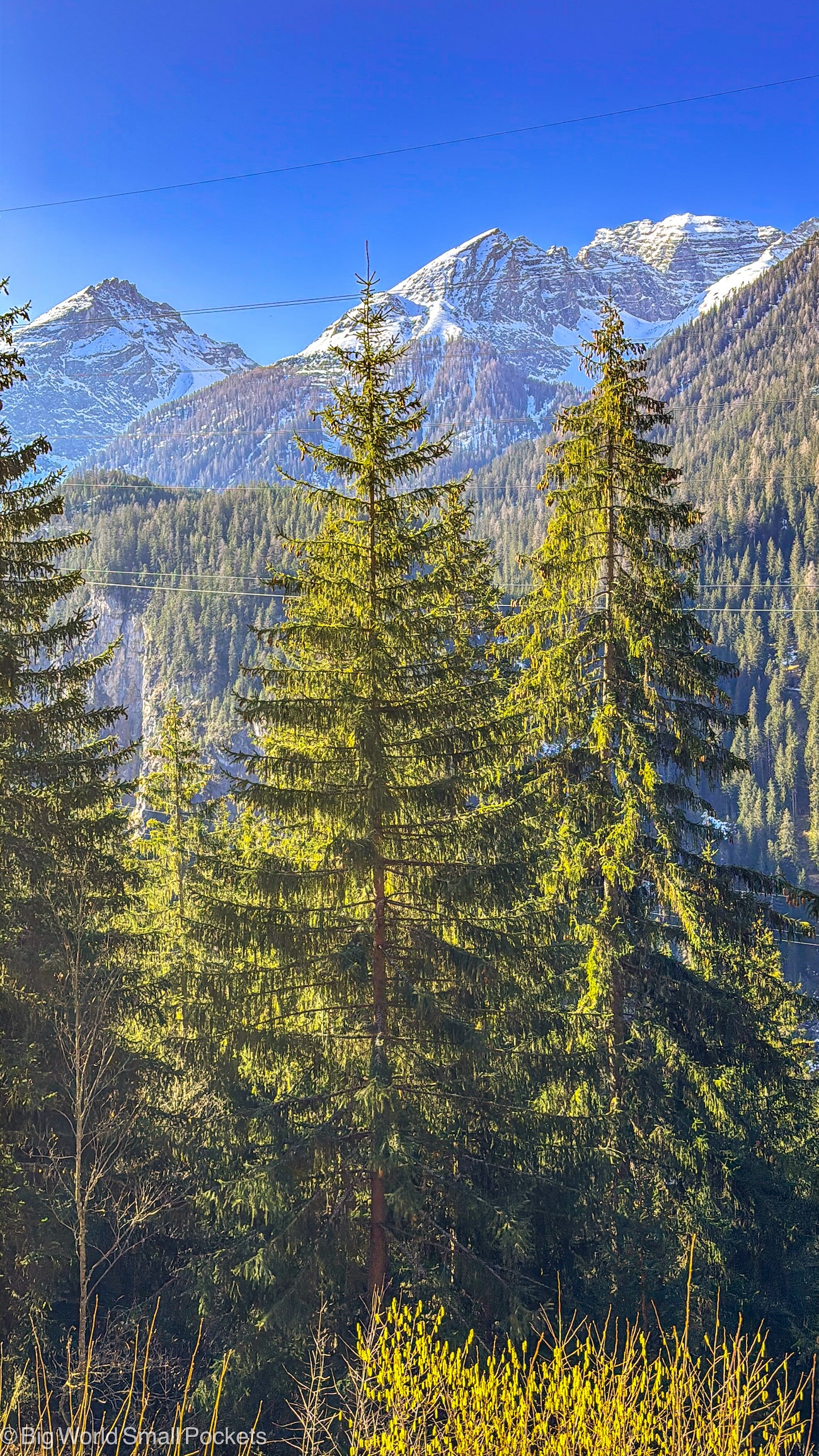
Being able to slide down the window means clear shots of the Landwasser Viaduct, the Morteratsch Glacier and Lago Bianco without reflections.
It is also a great way to feel the temperature shift as you climb through the track’s different altitudes.
Are the Views Genuinely Identical?

Without exaggeration, yes!
The entire Bernina line is a single track that all trains share, so whether you are on the Bernina Express or the regional service, the scenery is exactly the same.
The Landwasser Viaduct, the spiralling loops around Bergün, Lago Bianco, the Morteratsch Glacier and the dramatic drop into Poschiavo are all experienced from the same angle.
The only difference is the carriage design.
With the regional train you trade the huge, panoramic glass bubble for traditional, smaller windows that open.
For many travellers, especially photographers, the regional trains offer the better option, because you can lean slightly out for clean shots without reflections.
Any Downsides?
There are only two real trade-offs to catching the regional train over the Bernina Express.
You do not get the giant panoramic windows, and your journey will typically involve one or two changes. That’s really it.
If you are someone who loves a spotless, curated sightseeing experience, the Bernina Express is gorgeous.
If you enjoy getting the same scenery for less money, with better photography opportunities and a little more spontaneity, the regional option is the clear winner.
Cost Comparison: Bernina Express vs Regional Train
People often ask how much money you actually save by taking the regional train instead of the Bernina Express and the answer varies a little depending on the time of year.
However, the pattern is always the same.
The Bernina Express requires two payments…
- The base rail fare
- The compulsory seat reservation
This seat reservation is where the cost jumps, particularly in summer when it can be relatively high.
The regional train only requires one payment…
- The base rail fare
There is no reservation and no surcharge. This can easily reduce the overall cost by about half.
It is one of the rare occasions in Switzerland where travelling like a local genuinely saves you a significant amount without compromising on experience.
As an example, Bernina Express total ticket costs usually start from around CHF 78 in second class, roughly £73.
The regional train starts from around CHF 32, about £30, depending on passes and promotions.
That is genuinely half the price!
When Should you Choose the Bernina Express Instead?

The Bernina Express is still a wonderful journey and there are times when it might suit you better.
If you love a polished sightseeing experience, with massive glass windows and a curated tourist feel, then the Bernina Express is designed exactly for that.
If you prefer a guaranteed seat with no need to arrive early, the reservation system ensures you have your spot.
For anyone who wants flexibility, open windows, cheaper fares and easy photography, the regional train wins every time.
Step by Step: How to Book

To help pull it all together, here is the simplest path to riding the Bernina route for half the price…
- Search your journey on the SBB website, SBB app or Trainline
- Ignore any train labelled BEX and choose trains labelled IR, RE or R instead
- Book the standard ticket only
- Arrive 15-20 minutes before departure for the best window seat (a little more time in summer)
- Enjoy the exact same UNESCO route for a fraction of the cost
Travel Tips for the Bernina Express Journey

How to Get to the Bernina Express
Most people begin their train ride in the Swiss city of Chur.
The easiest airport for Bernina Express train rides is Zurich.
From there, you can catch an easy train to Chur via Zurich Hbf (one change). The journey takes less than 2 hours.
Book your tickets through Trainline.
From the station, it’s then just a short walk to Chur’s Old Town.
Where to Stay in Chur
Hotel Stern – this lovely historic property in the centre of Chur comes highly recommended.
Travel Insurance
World Nomads offers simple and flexible travel insurance. Buy at home or while travelling and claim online from anywhere in the world.
Alternatively, if you’re a long-term traveller, digital nomad or frequent remote worker seeking travel health cover, check out Safetywing’s Nomad Insurance policies.
eSIM for Switzerland
I recommend Holafly’s unlimited data eSIMs for Switzerland.
Get 5% off yours with my exclusive discount code: BIGWORLDSMALLPOCKETS.
Luggage Storage
Store luggage for the day, or longer in Switzerland with LuggageHero.
Travel Money
Switzerland uses the Swiss France (CHF).
I always travel Europe with my Wise card, which makes spending abroad cheaper, thank to real exchange rates and no sneaky transaction or ATM fees – grab yours here.
SAVE THIS ARTICLE TO PINTEREST!
Switzerland has a reputation for being eye-wateringly expensive, and sometimes it absolutely earns it, but taking the regional train is a rare, wonderful exception.
One of the best-value travel hacks in Switzerland, you get all the epic glaciers, viaducts and mountain drama without the premium price tag.
It is scenic, simple, wonderfully affordable and perfect for anyone who wants to experience the Bernina line without the pocket pinch!
Keep travelling smart and enjoying the view!
This page contains affiliate links meaning Big World Small Pockets may receive a small commission on any purchases at no extra cost to you.
